
Arbitration stays in the Isle of Man
Appeal Division sets out the two-stage approach to arbitration stays under section 5 of the Arbitration Act 1976
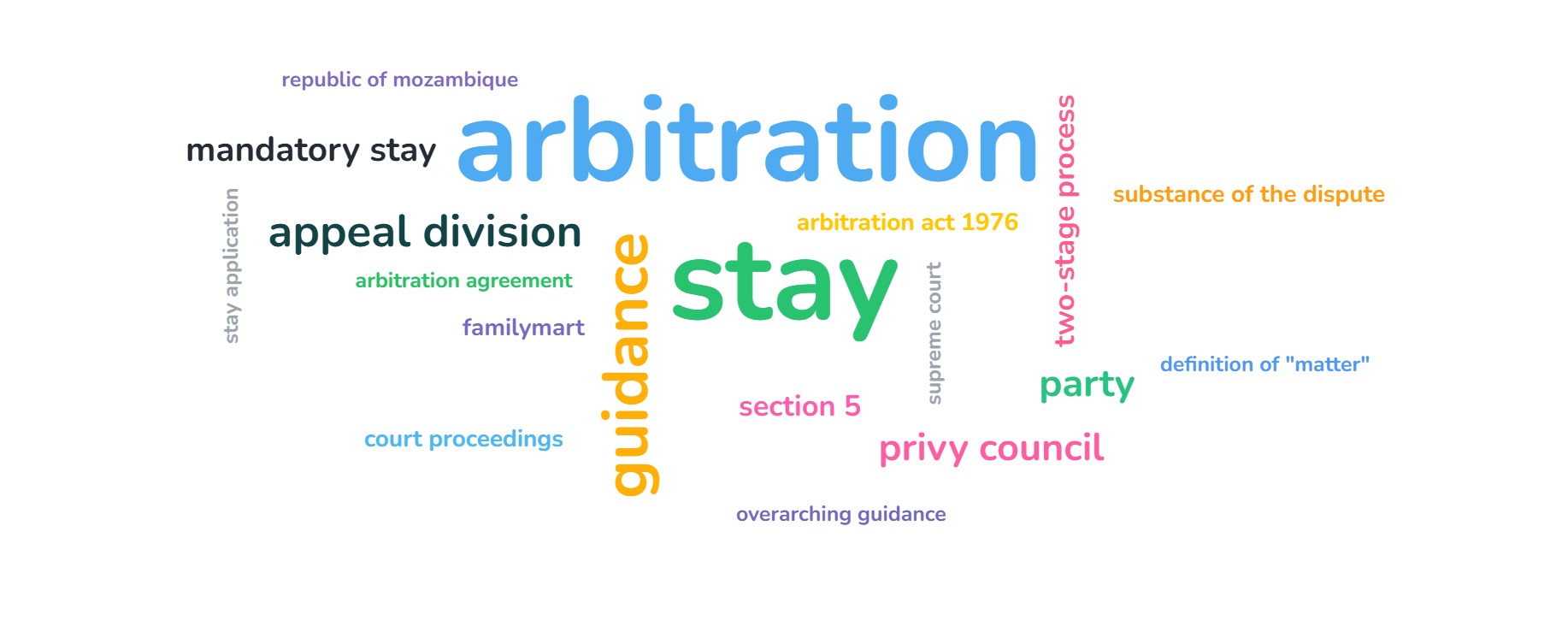
In McNally & another v Glen Moar Properties Ltd (in liquidation in the BVI) (2DS 2023/04) (16.01.24), a distinguished Appeal Division set out the Isle of Man Court’s approach on an application for a stay of legal proceedings under s 5 of the Arbitration Act 1976 (of Tynwald). Section 5 provides:
“If any party to an arbitration agreement to which this section applies… commences any legal proceedings in the Court against any other party to the agreement… in respect of any matter agreed to be referred, any party to the proceedings may at any time after appearance, and before delivering any pleadings or taking any other steps in the proceedings, apply to the Court to stay the proceedings; and the Court, unless satisfied that the arbitration agreement is null and void, inoperative or incapable of being performed or that there is not in fact any dispute between the parties with regard to the matter agreed to be referred, shall make an order staying the proceedings” .
The Appeal Division (Judge of Appeal Cross KC, Acting Deemster Sir Nigel Teare and Acting Deemster Moran KC) applied decisions of the Supreme Court in Republic of Mozambique (acting through its Attorney General) v Privinvest Shipbuilding SAL (Holding) & others [2023] UKSC 32 and the Judicial Committee of the Privy Council in FamilyMart China Holding Co Ltd v Ting Chuan (Cayman Islands) Holding Corporation [2023] UKPC 33). At § 30, the Appeal Division held:
“… the legal approach this court must follow… and which is to be followed henceforth in the Isle of Man on applications for a stay of legal proceedings under [s] 5 of the 1976 Act, is that now comprehensively set out in the FamilyMart decision”.
Key points
The following key points in McNally set out the Appeal Division’s approach, based largely on FamilyMart:
[1] “The court… adopts a two-stage process. First, the court must determine what the matters are which the parties have raised or foreseeably will raise in the court proceedings, and, secondly, the court must determine in relation to each such matter whether it falls within the scope of the arbitration agreement” (McNally, § 35);
[2] “The court must ascertain the substance of the dispute… This involves looking at the claimant’s pleadings but not being overly respectful to the formulations in those pleadings which may be aimed at avoiding a reference to arbitration. It involves also a consideration of the defences, if any, which may be skeletal as the defendant seeks a reference to arbitration, and the court should also take into account all reasonably foreseeable defences to the claim or part of the claim” (McNally, § 36);
[3] “… section 5 of the 1976 Act… contemplates fragmentation of the legal proceedings” (McNally, § 38);
[4] “a “matter” is a substantial issue that is legally relevant to a claim or a defence, or foreseeable defence, in the legal proceedings, and is susceptible to be determined by an arbitrator as a discrete dispute. If the “matter” is not an essential element of the claim or of a relevant defence, it is not a matter in respect of which the legal proceedings are brought…” (McNally, § 39);
[5] “… A court… should approach the question in a practical and common-sense way. The court must respect the agreement of the parties to arbitrate their disputes. An agreement to arbitrate a dispute is an agreement not to resolve that dispute in court proceedings. Thus, any substantial matter in the legal proceedings, which is relevant to the claim or foreseeable defence, and which is within the scope of the arbitration agreement, will give rise to a mandatory stay of the legal proceedings pro tanto on the application of one of the parties… [T]he procedural complexity caused by a reference to arbitration does not of itself render a matter non-arbitrable… That does not mean that procedural complexity is irrelevant in all circumstances because the court… should be careful to prevent an abuse of process… [T]he court could refuse an otherwise mandatory stay if the applicant has no real or proper purpose for seeking the stay. That could include not only an application for a stay in relation to issues that were peripheral to the legal proceedings but also an application that amounted to an abuse of process…” (McNally, § 42);
[6] “… the… judicial evaluation of the substance and relevance of the “matter” entails… judgment and… common sense… It is not sufficient merely to identify that an issue is capable of constituting a dispute… within the scope of an arbitration agreement without carrying out an evaluation of whether the issue is reasonably substantial and whether it is relevant to the outcome of the legal proceedings… (McNally, § 43); and
[7] “The approach to the word “matter”… set out… above may involve the fragmentation of the parties’ disputes with some matters being determined by an arbitral panel and other matters being resolved by the court… The disadvantages caused by such fragmentation can be mitigated by effective case management by both the court and the arbitral panel” (McNally, § 43).
Note for practitioners: In FCS Ltd v Hiscox Insurance Company Ltd (ORD 2019/46) (26.01.21), Deemster Corlett noted (at §42):“… it appears to me that the Manx arbitration legislation has fallen well behind the times. Tynwald should consider whether, as an international finance centre, we need to have legislation which is better able to address arbitrations and disputes relating thereto which often have a multi-jurisdictional flavour”. The Appeal Division in McNally added (at §105): “This court wishes to express its wholehearted agreement with that comment of the First Deemster made three years ago, and also respectfully urges Tynwald to embark upon the consideration he recommended. The court also notes that it is a particularly propitious moment for such consideration, with the benefit of an extensive consultation process for amendment of the Arbitration Act 1996 of Parliament having recently taken place; and with proposed amendments to that legislation having been recommended by the Law Commission, which are now awaiting enactment. The court directs that a copy of this judgment should be provided to the Attorney General for his consideration and appropriate action.” It will be interesting to see whether Tynwald decides to legislate as proposed.
Disclaimer: professional advice should be sought before applying any information in a given case.
For advice on Isle of Man civil procedure, or arbitration, contact Coren Law.
See also Coren Law’s Isle of Man civil procedure portal: Click On | Coren Law.
More News
Stay up to date with more of our latest news updates.

EET: interim relief whistleblowing change may “create a perfect storm”
EET deals with application to postpone interim relief hearing in whistleblowing case - and highlights logistical issue with new legislation

Cryptocurrency fraud, civil law & the Isle of Man
Isle of Man likely to be impacted by recent English decisions in Smithers and Yuen

Asset disclosure order: new affidavit permitted (first one “not good enough”)
Freezing order also remains in place, in high-value, cross-border estate dispute